

External Links
Interview(s) below aren't available on our site but may be available online from partner sites. If not, please contact the partner archive directly to arrange access.

Interviewee Summary
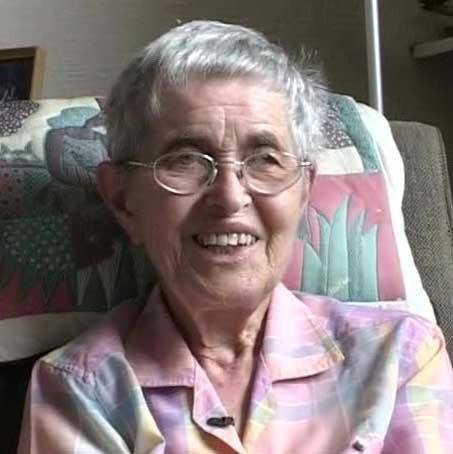
Elisabeth Bernheim was born in 1920 in Riedlingen, Germany. Her father ran the family drapery and haberdashery shop in the town, and they lived above the shop with her mother’s mother. There were only three Jewish families in the town, and the Bernheims would travel to Buchau for Rosh Hashanah and Yom Kippur.
Elisabeth had two younger brothers: Eric, born 1922 and Kurt, born 1931. She attended the local school until the age of fifteen and also had private Hebrew lessons. She did not experience antisemitism personally. When she was fifteen Elisabeth went to a Jewish school/Hachsharah camp in Wolfratshausen near Munich, and a year later she went to stay with the family of Dr Happ in Freienwalde near Berlin, and was taught childcare and domestic duties. She subsequently started to work at the kindergarten of Mrs Wolfheim in Berlin.
Elisabeth was in Berlin during Kristallnacht. In Riedlingen her father’s shop was untouched but another one managed by a Jew was ransacked.
In March 1939 the kindergarten where Elisabeth worked closed. Her younger brother Kurt, who was eight years old, was sent on the Kindertransport to live with a family in London. In June, Elisabeth also moved to the UK, as a domestic worker to a family of a missionary, who were on holiday in Edinburgh. Her brother Eric went with his ORT school to a hostel in Leeds in August.
Elisabeth was happy to have left Germany and was happy with the family who employed her. When they left Edinburgh, she went to her aunt and uncle in Leicester, where they found her a position with a Jewish family as a maid. In 1943 she went to Leeds to be near her brother Eric, and took a job in a grocery shop. Eric left shortly afterwards to join the army.
After the war had ended, Elisabeth discovered from a distant relative who survived that her parents had been killed. In 1949 she decided to take up nursing and trained at Leeds University for three years and followed by another year of midwifery training. She practised as a Community Midwife in the Headingly area of Leeds until retiring in 1980.

Testimonies
28 July 2003
Institution
External Link
External Link
External Link


INTERVIEWEE:
Elisabeth B.
Born:
1920
Place of birth:
Riedlingen der Donau
Photos
Caption
Institution
External Link
External Link
External Link

Caption
Institution
External Link
External Link
External Link
Caption
Institution
External Link
External Link
External Link
Maps
Place of Birth
Riedlingen der Donau
Place of Interview
Location
Recorded Talks
Place of Birth
Riedlingen der Donau
"The whole reason that we have this interview is to let future generations know what kind of life of we had so they should have a better life, not have to suffer through all the traumas we had to suffer. As time goes on the memory of those days and the importance of it will dim, and this programme will help keep it in people's minds and hopefully let future generations have a better life. It should be a better world."
- Arnold Weinberg, AJR Refugee Voices Testimony Archive.
"The distribution of life chances in this world is often a very random bus"
- Peter Pultzer.

Experiences:
Tag